Thursday, 10 February 2011

Monday, 31 January 2011
GRAMMAR OF THE SHOT
After I have studied the shooting techniques used in movies such as Matrix and Blade Runner in order to give that futuristic-dystopian reading of the architectural elements within the shots, I have decided to go back to the site and I have tried to apply the same techniques myself.
Although the technical result is not amazing (due to the lack of correct technical equipment and shooting skills) the exercise has been really useful in order to experiment and experience the spatial techniques I am investigating.
Shooting the short movie below made me more aware of the spatial experience within the cinematic context and this will be really useful for the development of my project.


Monday, 24 January 2011
SCOMPOSING IN LINES


The conceptual drawings above show how the architecture of the National Theatre can be scomposed and perceived just in vertical and horizontal lines.
I was really fascinated by the extreme verticality and horizontality of the architectural shapes because these are the interesting elements you can use in the cinematic grammar in order to create that dystopian effect proper of the kind of movies I am analyzing.
FURTHER ANALYSIS OF SCI-FI MOVIES
The analysis below expresses the spatial movements and theories behind the making of some of the most known and influential movies within the context of dystopian futures and architecture.
I have tried to analyze these aspects from the grammar shot point of view in order to understand the techniques which allow to create a certain dystopian and oppressive feeling of fear and anxiety through architecture and space perception.
I have then tried to spot the similarities between these shots and the Southbank architecture.THE MATRIX

BLADE RUNNER


Monday, 6 December 2010
A SYMPHONY OF (HORROR) ARCHITECTURE
The video has been shot using the shadows projected on a withe cloth, created with a small spot light.
The aim is to create an horror atmosphere where architecture becomes alive and it starts taking over the humans being.
In the movie architecture has got its own willing and personality and is revolving and changing around the astonished people.
Humans are not anymore in control of the space but is the space that is in control of them and is dictating their mood, actions and fears. STORYBOARDS


MOVEMENTS OF LIGHTS
 |
| buildings opening |
 |
| city moving on the right side |
 |
| city getting bigger |
BACKSTAGE
Here the pictures of the set


Saturday, 4 December 2010
STUDIES ON ATMOSPHERE AND SPACE IN THE EXPRESSIONIST MOVIES
After the First World War the German filmmakers trained and influenced by the German expressionist movement found difficult to create movies that could be compared with the expensive features coming from Hollywood and for this reason they started conceiving and developing their own style by using symbolism and a "mise en scene" more focused on the mood, atmosphere and human experiences.
Expressionist movies made up for a luck of money and investors by using simple and conceptual set designs with painted panels/canvas to represent lights, shadows and objects.
The plots and stories were mainly focused on themes such as madness, mental instability, double personality, anxiety and other intellectual and psychological topics.
In this movie genre there is a direct and strong relationship between cinema and architecture and strong elements of monumentalism and modernism are constantly used and addressed.
This genre of movies can be considered the father of later horror movies and "film noir", besides the fact that some similar spatial and architectural features can be depicted in contemporary movies such as Blade Runner(by Ridley Scott) and some of Tim Burton's movies. In this movie genre there is a direct and strong relationship between cinema and architecture and strong elements of monumentalism and modernism are constantly used and addressed.
In the creation of space, set design and architecture expressionist were giving a key role to shadows and lights, elements highly used to suggest and represent the mood of the characters and to lead the viewer through a dark and anxious mood.
EXAMPLES OF EXPRESSIONIST MOVIES
THE CABINET OF DOCTOR CALIGARI (Germany, 1920, Robert Wiene)
The Cabinet of Doctor Caligari is considered as one of the most influential movie within the German expressionist movement and is also regarded as the father of all the following horror movies.
The representation of spaces and architecture in the movie is extremely interested and innovative for the time in addition to the fact that it is really effective in creating an horror atmosphere and projecting in the space the mood and the mind of the characters.
Lights and shadows are directly painted on set walls, floors and background and mainly the set behind the actors is flat although it gives a great effect and creates the right atmosphere. 

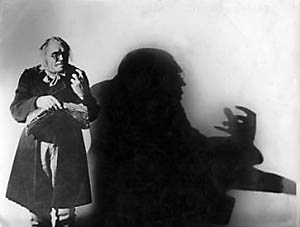
The staircase scene (below) shows a great examples in the use of lights and shadows to create the suspense atmosphere and to give that sense of fear and danger.


Thursday, 2 December 2010
EXPERIMENTING WITH LIGHTS AND SHADOWS
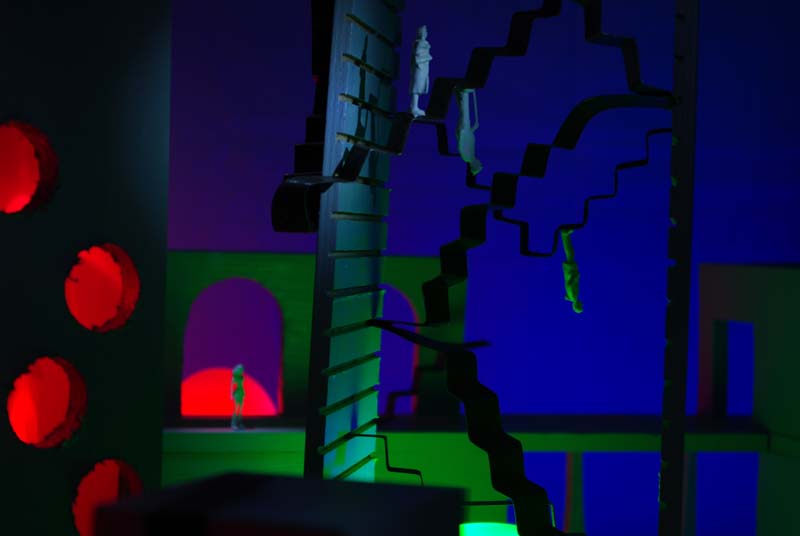
In the process of investigating how to make architecture behave in order to be the main character and how to choreograph architecture I have decided to test and experiment on a small and artificial space....So I have decided to build a model trying to follow the architectural features of the brutalist architecture.
And I have started experimenting with lights and shadows to create the atmosphere and feeling of architecture taking over and becoming in control of the scene.
In the model the architecture is reverse and put upside down to give the feeling of a constantly changing space and of a psycho space.
PICTURES OF THE MODEL


And I have started experimenting with lights and shadows to create the atmosphere and feeling of architecture taking over and becoming in control of the scene.
In the model the architecture is reverse and put upside down to give the feeling of a constantly changing space and of a psycho space.
PICTURES OF THE MODEL




Subscribe to:
Posts (Atom)